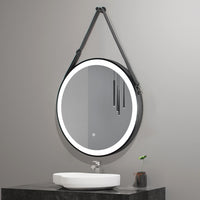
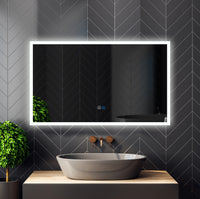
Backlit mirrors are the ones you save to a moodboard. Frontlit mirrors are the ones you can actually shave by. That is the whole trade-off — and for most bathrooms it resolves in favour of frontlit, though not for the reason most comparisons give. Here is how each one behaves, and which belongs on your wall.
What do backlit and frontlit actually mean?
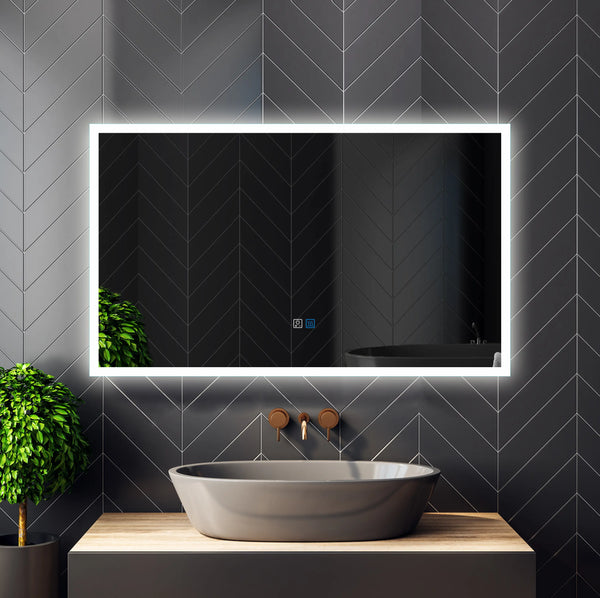
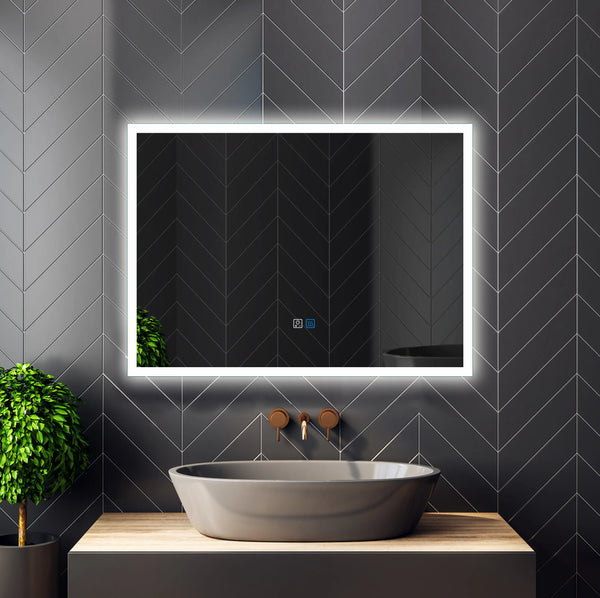
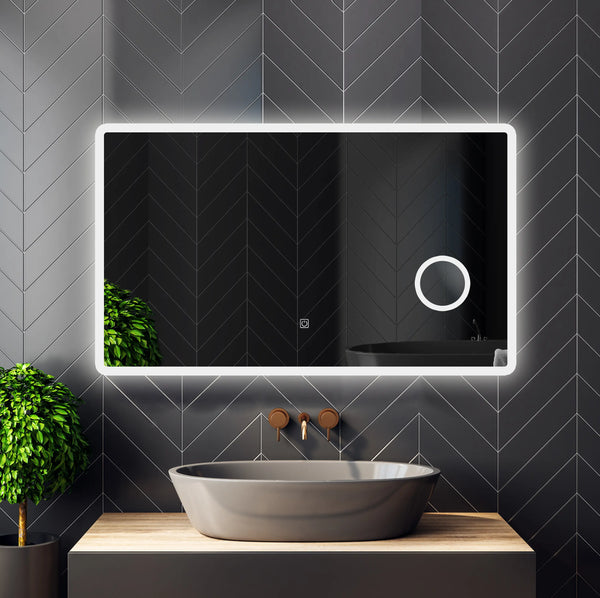
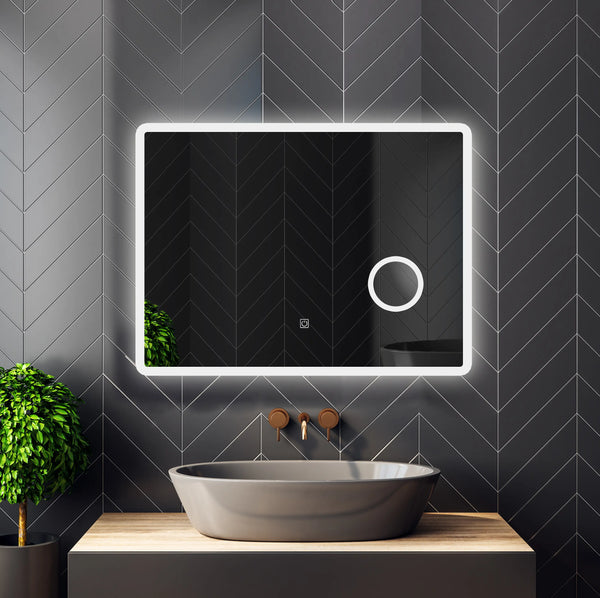
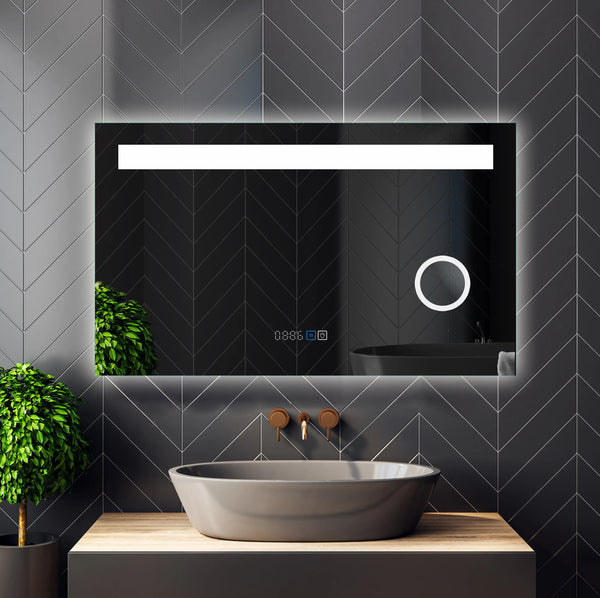
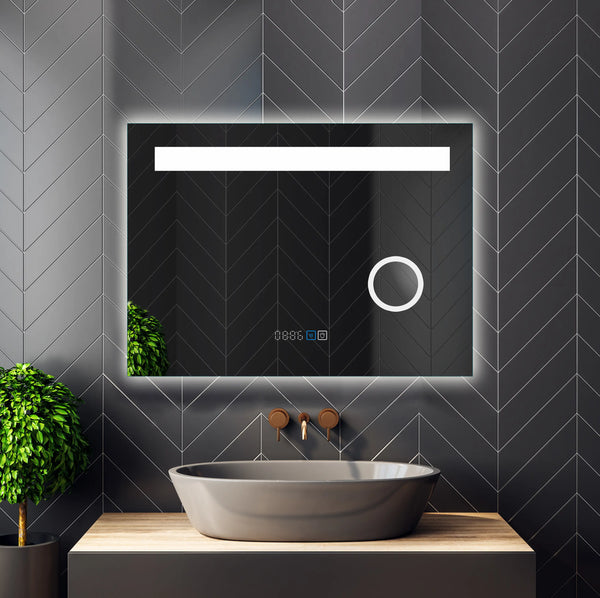
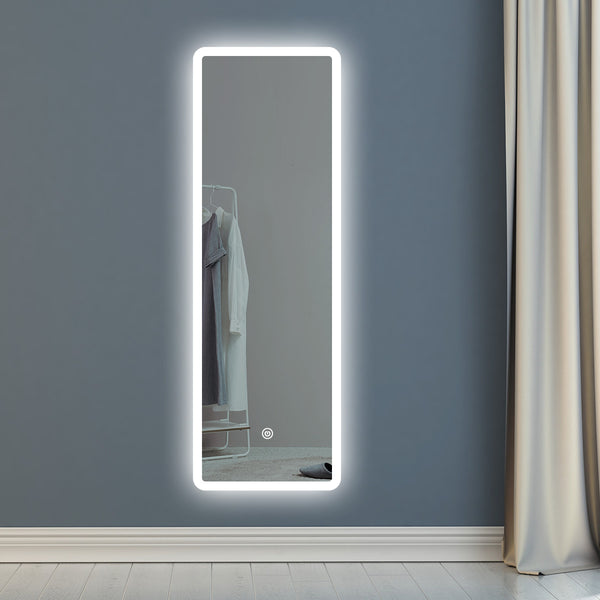
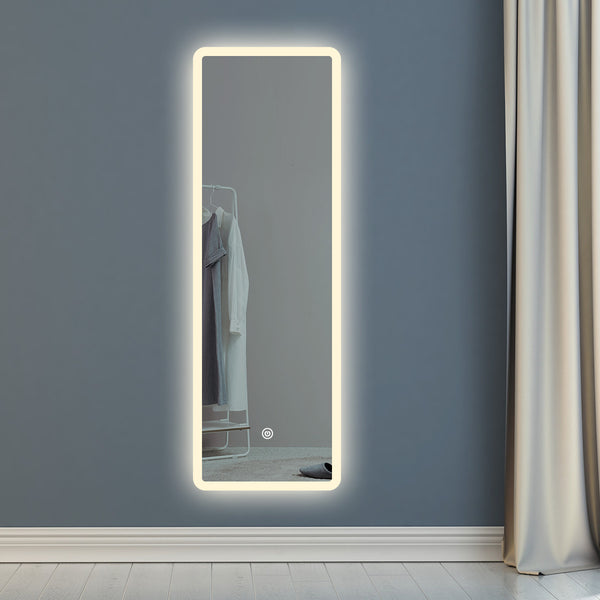
The names describe where the LEDs sit. A backlit mirror hides its light strip behind the glass, so the light escapes around the edges and washes the wall, leaving a halo that makes the mirror look like it is floating. A frontlit mirror puts the strip on the face of the glass — a lit band down each side, around the whole perimeter, or a frosted panel — so the light travels forward, into the room and onto you.
That single difference decides everything else: how well you can see your own face, how the room feels, and how much other lighting you still need. A dual-lit mirror does both, on separate controls.
Which one actually lights your face?
Frontlit, and it is not close. A backlit mirror sends its light behind the reflective surface. What reaches your face is the fraction that bounces off the wall and comes back — soft, flattering, and rarely enough to work by. Grooming is detail work: plucking a brow, blending along a jawline, shaving under the nose, putting in a contact lens, checking a mole you have been watching. All of it needs light arriving on the front of your face, not behind your head.
A frontlit mirror does exactly that. It sits at face height and throws light forward, filling the shadows under the brow, nose and chin that a ceiling fixture carves in. Every mirror we sell runs a CRI above 90, so skin tone and makeup read the same in the glass as they will outside.
Which one makes the room look better?
Backlit, genuinely. The halo does something a frontlit mirror cannot: it dissolves the hard edge where glass meets tile, so the mirror appears to hover. It adds depth to a flat wall, reads as considered rather than simply bought, and photographs beautifully — which is why nearly every bathroom you have admired online is lit this way.
If the mirror is a design decision first and a grooming tool second — a powder room guests use for thirty seconds, or a bathroom with a separate makeup station — that is a real reason to choose backlit, and we would not talk you out of it. The mistake is choosing it for a bathroom that has to do real work at 7am and expecting the light to keep up.
Does your wall colour change the result?
For a backlit mirror, more than anything else on this page. The halo you see is light that has hit the wall and come back, so the wall is doing half the work. A white or pale wall returns most of it and the glow reads wide and generous. A charcoal, navy or deep green wall absorbs it, and the same mirror produces a thin outline instead of a halo — still handsome, but a fraction of the effect you were picturing.
Textured tile splits the difference: grout lines and relief catch the light and break the halo into something patchier. None of this touches a frontlit mirror, which throws its light into the room regardless of what is behind it. If your wall is dark and you want the backlit look, that is worth knowing before you order rather than after.
The thing most comparisons get wrong
Almost every comparison frames this as beauty against function, then suggests you buy both. But ask why people want the backlit look and the answer is usually the quality of the light: soft, warm, unhurried, nothing like the flat white of an overhead fixture.
That is not something only backlighting can produce. Every mirror in our 3-colour line runs warm, natural and daylight settings on a touch switch, with dimming on top. At the warm setting, turned down, a frontlit mirror gives you the same low golden light people are buying backlit for — and it still lands on your face. The trade-off everyone describes is largely an artifact of mirrors that run one fixed colour temperature at one brightness. Ours do not.
Which works in a small or windowless bathroom?
Frontlit again, for a specific reason. Backlit mirrors look right in photographs because those bathrooms have other light — a window, recessed ceiling cans, a sconce. The halo is a layer on top of that, not the whole lighting plan. A small or windowless bathroom has no such layer. Put a backlit mirror in one and the room is lit by a glow bouncing off the wall behind it: atmospheric at ten at night, useless at seven in the morning.
A frontlit mirror carries the room on its own. In a compact bathroom it is often the only light worth having — which is also why anti-fog matters more there than anywhere else.
Is one harder to install than the other?
Not in practice. Every lighted mirror we sell arrives ready to plug into a standard US 120V outlet, and can be hardwired instead if you would rather hide the cord — that route is an electrician's job, not a weekend one. The single exception is our 34×26 medicine cabinet, which is hardwired only.
The detail worth checking first is the outlet. A plug-in mirror needs one within reach of its cord and ideally behind the glass, where the cord disappears. If your only outlet sits beside the vanity at counter height, you will either see the cord or want an electrician to move it — which is the moment most people decide hardwiring was worth it after all.
Backlit mirrors sit slightly further off the wall to leave the light room to escape; frontlit mirrors sit flatter. Neither changes the bracket or the mounting. All of them are IP44-rated for a damp bathroom, and all of them ship by parcel carrier — they weigh between 17 and 31 pounds, so plan a second pair of hands rather than a delivery appointment.
What about cost and running cost?
A dual-lit mirror costs more than either single type, because it is two lighting systems with two sets of controls. Between backlit and frontlit alone, the difference at any given size is small enough that price should not decide this for you.
Running cost is not a real factor either, whatever you read elsewhere. An LED mirror left on an hour a day costs pennies a year in any of the three configurations, and the strips are rated for 30,000 hours. Anyone presenting energy efficiency as the reason to pick one over the other is padding an argument. The costs that actually vary are size, anti-fog and smart features — compare on those.
When is a dual-lit mirror worth it?
When you want the halo and usable light, have the wall for it, and will genuinely use both. It is the honest answer for a primary bathroom where one mirror has to do everything — the soft setting in the evening, the front light when you need to see.
Our dual-lit mirror is a single 24×32 rectangle with independent front and back lighting, anti-fog, and a memory function that returns to your last setting. That is the whole dual-lit range at the moment — one mirror, one size. If it fits your vanity it is an easy recommendation; if it does not, a frontlit mirror at its warm setting gets you most of the way there.
So which should you buy?
Frontlit, for most people and most bathrooms. It lights your face properly, it works as the only light in a small room, and dimmed to warm it still gives you the calm glow that makes backlit mirrors appealing in the first place.
Choose backlit when the mirror is decor first and the room already has light it can lean on. Choose dual-lit when you want both and the 24×32 suits your vanity. Whichever you pick, measure the counter before you measure the mirror — a vanity mirror looks right sitting two to four inches inside the counter edge on each side, and getting that wrong will bother you far longer than the lighting will.
Is a backlit or frontlit mirror better for makeup?
Frontlit. Makeup needs light arriving on the front of your face, filling the shadows under the brow, nose and chin. A backlit mirror lights the wall behind the glass, so your face is lit by what bounces back — flattering, but too soft to blend by. Look for a CRI above 90 so colours read true.
Do backlit mirrors give enough light for a bathroom?
Not on their own, in most bathrooms. A backlit mirror adds an ambient layer on top of other lighting — a window, ceiling lights, a sconce. If it is the only fixture in the room you will find yourself leaning in to see. In a small or windowless bathroom, choose frontlit.
What does dual-lit mean on an LED mirror?
Dual-lit means the mirror has both: an LED strip behind the glass for the halo, and one on the face for task light, on separate controls. You can run either alone or both together. It is the most flexible option and the most expensive, because it is two lighting systems in one mirror.
Can you use a backlit mirror as the only light in a bathroom?
You can, but you probably should not. The light reaches you only after bouncing off the wall — fine for finding the door at night, frustrating for anything needing detail. If the mirror has to be the room's only light source, a frontlit or dual-lit mirror is the better choice.
Are frontlit LED mirrors more expensive than backlit?
Not meaningfully. At the same size and feature set the two sit close enough that price should not decide it. Dual-lit mirrors do cost more, because they carry two lighting systems. Compare on size, colour temperature and whether you need anti-fog instead.
Do backlit mirrors work in a small bathroom?
They look excellent in one — the halo keeps a tight room from feeling boxed in. But a small bathroom rarely has the other light a backlit mirror needs to supplement. If the room has a window or good ceiling lighting, backlit works. If not, go frontlit.